CHEM 1A: General Chemistry
Introduction to general chemistry, covering fundamental laws, atomic structure, chemical bonding, naming conventions, stoichiometry, and solutions.
Chemistry 1A: General Chemistry
Modern Fundamental Laws
- Law of Conservation of Mass: mass is neither created nor destroyed in a chemical reaction.
- Law of Definite Proportion: a given compound always contains the same proportion of elements by mass.
- Law of Multiple Proportions: when two elements form multiple compounds, the mass ratios can be reduced to small whole numbers.
Atoms
- Protons: Positively charged subatomic particles found in the nucleus of an atom. They determine the atomic number and identity of an element.
- Neutrons: Chargeless subatomic particles also found in the nucleus. They contribute to the atomic mass but do not affect the charge of the atom.
- Electrons: Negatively charged subatomic particles that orbit the nucleus in electron shells. They are involved in chemical bonding and reactions.
Atomic Symbols
- Elemental Symbol: A one- or two-letter abbreviation for an element (e.g., H for hydrogen, O for oxygen).
- Atomic Number: The number of protons in the nucleus of an atom, which defines the element.
- Mass Number: The total number of protons and neutrons in the nucleus of an atom.
- Nuclear Symbol: A notation that includes the mass number and atomic number. (e.g. for carbon-12)
Types of Atoms
- Elementary Substances: Pure substances that consist of only one type of atom. They can be classified as:
- Monoatomic: meaning they consist of single atoms. (e.g., He, Ne)
- Diatomic molecules (e.g., O₂, N₂) or polyatomic molecules (e.g., S₈).
- Isotopes: Atoms of the same element that have different numbers of neutrons, resulting in different mass numbers. Isotopes can be stable or radioactive.
Periodic Table
- Elements are organized by increasing atomic number.
- Each element in a cell contains its elemental symbol, atomic number, and the atomic mass. Atomic mass is the weighted average of the masses of an element's isotopes.
- Rows are called periods and columns are called groups.
- Broadly, metals are on the left and center, while nonmetals are on the upper right.
Molecules and Chemical Bonds
- Atoms can combine by sharing electrons in a covalent bond to form a molecule.
Ways to Represent Molecules
- Chemical formula: shows how many of each atom are present, but not connectivity.
- Structural formula: shows atoms and bonds.
- Space-filling model: shows relative atom size and occupied space.
- Ball-and-stick model: shows bonds clearly with 3D spheres.
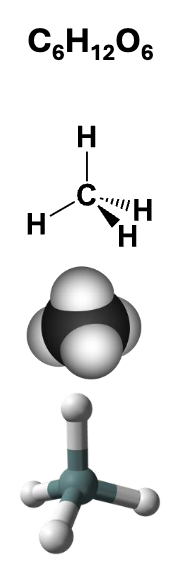
Ions
- Ions: atoms or molecules with a net charge due to an imbalance of protons and electrons.
- Simple ions: single atoms that have gained or lost electrons. Examples include , , and .
- Polyatomic ions: groups of atoms that together have a net charge. Examples include (ammonium) and (sulfate).
- Cations: positively charged ions with more protons than electrons. (, , )
- Anions: negatively charged ions with more electrons than protons. (, , )
- Ionic Compounds: compounds formed from cations and anions held together by ionic bonds. The electrons in ionic bonds are not shared but transferred from one atom to another, resulting in the formation of ions.
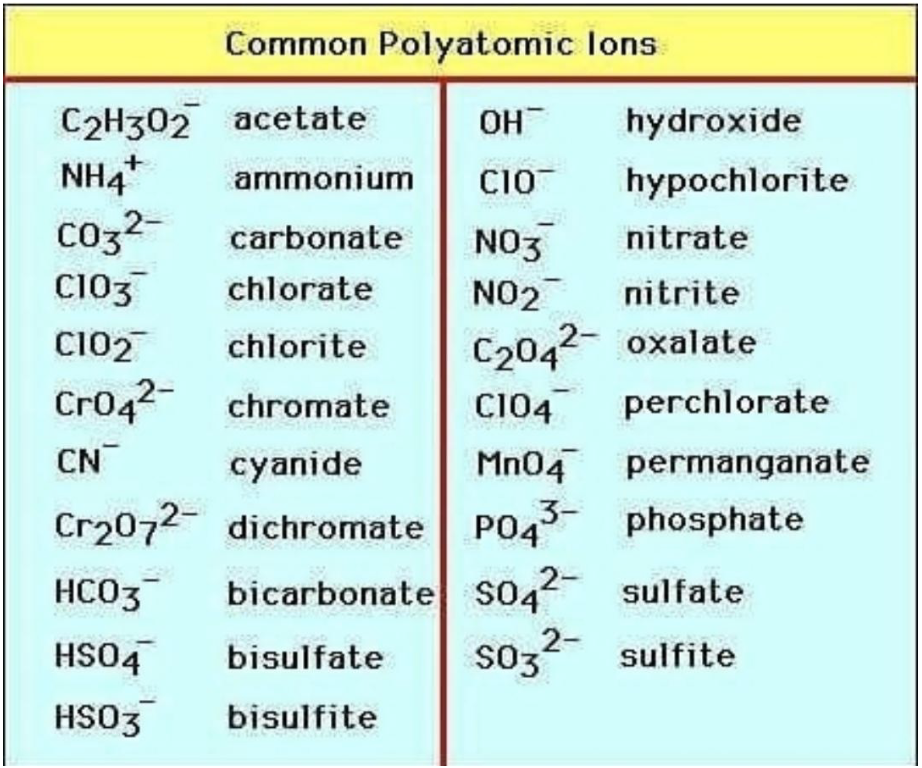
Determining Charge
- Group 1 elements usually form +1 ions.
- Group 2 elements usually form +2 ions.
- Group 13 elements usually form +3 ions.
- Group 14 elements can often be .
- Group 15 elements usually form -3 ions.
- Group 16 elements usually form -2 ions.
- Group 17 elements usually form -1 ions.
- Group 18 elements are very difficult to ionize and are usually found as neutral atoms.
Covalent and Ionic Bonds
- Elements on the left side of the periodic table are generally more stable as cations. Elements on the right side are generally more stable as anions.
- Observations:
- Metal + nonmetal usually gives an ionic compound.
- Nonmetal + nonmetal usually gives a covalent compound.
Naming Chemical Compounds
Type I Binary Ionic Compounds
- These contain one type of cation and one type of anion.
- The cation has only one possible charge.
Naming Rules
- Name the cation first and the anion second.
- The cation keeps its element name.
- The anion uses the beginning of the element name plus
-ide.
Examples
- NaCl: sodium chloride
- HBr: hydrogen bromide
- : beryllium nitride
Acids
- Ionic compounds that begin with H are often treated separately as acids.
- For binary acids:
- Use hydro-
- Use the anion root
- End with
-ic acid
Examples
- HBr: hydrobromic acid.
- HCl: hydrochloric acid.
Type II Binary Ionic Compounds
- These involve metals, often transition metals, that can have more than one charge.
Naming Rules
- Name the cation first.
- Follow with a Roman numeral in parentheses showing the cation charge.
- Name the anion second using
-ide.
Examples
- : iron (III) chloride
- : copper (I) sulfide
- : cobalt (IV) nitride
Type III Binary Compounds
- These are covalently bonded molecules.
- They contain two nonmetal elements.
Naming Rules
- Name the first element first using its full element name.
- Name the second element like an anion, ending in
-ide. - Use numerical prefixes such as mono-, di-, tri-, and tetra- to show the number of atoms present. Mono- is used only on the second element, never the first.
Examples
- : carbon monoxide
- : dinitrogen trioxide
- : dinitrogen tetroxide
Chemical Formula vs. Empirical Formula
- Empirical formula: the simplest whole-number ratio of elements in a compound.
- Chemical formula: the formula that gives the actual number of each type of atom in the molecule.
- Different compounds can have the same empirical formula but different chemical formulas.
Stoichiometry
SI System
International System of Units.
| Quantity | Meaning | SI Unit |
|---|---|---|
| Mass | measure of how a material resists change in motion | kilogram (kg) |
| Length | one-dimensional distance between two points | meter (m) |
| Time | duration of an event | second (s) |
| Temperature | thermal energy scale of a system | kelvin (K) |
| Amount of substance | quantity of particles / chemical entities | mole (mol) |
Temperature Scales: Kelvin (K), Celsius (), and Fahrenheit ().
SI Unit Prefixes
| Prefix | Symbol | Factor |
|---|---|---|
| atto | a | |
| femto | f | |
| pico | p | |
| nano | n | |
| micro | ||
| milli | m | |
| centi | c | |
| deci | d | |
| deka | da | |
| hecto | h | |
| kilo | k | |
| mega | M | |
| giga | G | |
| tera | T | |
| peta | P | |
| exa | E |
Atomic Mass
- Mass number is an integer for a specific isotope.
- Atomic mass is the weighted average mass of all naturally occurring isotopes. In atomic mass units (amu).
- In chemical reactions, use the atomic mass from the periodic table rather than a single isotope's mass number.
The Mole and Avogadro's Number
Avogadro's number:
Molar Mass and Mass Percent
The periodic table's atomic mass also gives the molar mass of a natural element in g/mol.
Molar mass is the mass of 1 mole of a substance. For an element, use the atomic mass from the periodic table and change the unit from amu/atom to g/mol. Example: C has atomic mass about 12.01 amu/atom, so its molar mass is 12.01 g/mol.
Chemical Reactions
- Reactants: starting materials
- Products: substances formed
- Reaction arrow: shows the direction from reactants to products
Percent Yield
- A limiting reactant is the reactant that gets used up first in a chemical reaction.
- Theoretical yield is the maximum amount of product that can be formed if the limiting reactant is used up completely.
- Percent yield compares actual product obtained to theoretical product expected.
Solution
- A solution is a homogeneous mixture of solute and solvent in the same phase.
- Solvent: the substance causing the dissolving.
- Solute: the substance being dissolved.
- Dissolve: moving the solute into the same phase as the solvent.
Electrolyte Solution
Dissociation: When ionic compounds dissolve in solution, they separate into ions (cations and anions).
- Compounds that dissociate in solution are electrolytes.
- Covalent molecules that dissolve but do not dissociate are nonelectrolytes.
Electrolyte Strength and Conductivity
- Strong electrolytes dissociate completely.
- Weak electrolytes dissociate only partially.
- Stronger electrolytes conduct electricity better because they produce more ions in solution.
Acids and Bases
Acids and bases are special types of electrolytes.
-
Acids: ionic compounds containing ions.
-
Bases: ionic compounds containing ions or help make in solution.
-
Strong acids/bases dissociate essentially 100% in solution.
-
Weak acids/bases dissociate only partially.
Examples:
- Strong acids: , , , , , ,
- Strong bases: , , , , , , ,
- Weak acids: ,
- Weak bases: ,
Concentration
Molarity:
Square-bracket notation like [NaCl] means the molar concentration of that solute.
Dilution
Dilution: lowering the concentration of a solution by adding solvent.
During dilution, the amount of solute stays constant while the total solution volume increases.
where = initial concentration, = initial volume used, = final concentration, = final volume
Precipitation
Precipitation: the formation of a solid compound from ions in aqueous solution.
A precipitate forms when two soluble ionic compounds react to produce an insoluble ionic compound.
Example:
Solubility Rules
| Anion | Soluble | Slightly Soluble | Insoluble |
|---|---|---|---|
| nitrate | All | --- | --- |
| acetate | Most | --- | |
| fluoride | Group 1, , | , , | , |
| chloride | Most | , | |
| bromide | Most | , | , |
| sulfate | Most | , | , , , |
| sulfide | Group 1 and 2, | --- | Most |
| carbonate | Group 1, | --- | Most |
| sulfite | Group 1, | --- | Most |
| phosphate | Group 1, | --- | Most |
| hydroxide | Group 1, , | , | Most |
Solubility categories:
- Soluble: dissolves more than about 10 g/L.
- Slightly soluble: dissolves about 0.1 to 10 g/L.
- Insoluble: dissolves less than about 0.1 g/L.
Net Ionic Equations
- Write the molecular equation.
- Write the complete ionic equation by dissociating all soluble strong electrolytes.
- Cancel spectator ions, which appear unchanged on both sides.
- The remaining reaction is the net ionic equation.
Example:
Complete ionic equation:
Net ionic equation:
Selective Precipitation
- Selective precipitation uses solubility rules to separate different ions from a mixture.
- A reagent is added that precipitates one ion while leaving others dissolved.
- The solid can be filtered out before adding another reagent.
Example: Separate , , and from nitrate salts.
- Add to precipitate .
- Add to precipitate .
- Add to precipitate .
Acid-Base Reactions
- Acid: a molecule that donates .
- Base: a molecule that accepts .
- Acid-base reactions often form water.
A neutralization reaction occurs when an acid and base react to form water and an ionic compound.
Titrations
- Titration: analysis of a solution where one solution is used to determine the amount or concentration of another.
- Titrant: the solution with known concentration used to analyze the unknown solution.
- Equivalence point: the point where enough titrant has been added to react exactly with the unknown substance.
Redox Reactions
Reduction-oxidation reactions, or redox reactions, involve electron transfer between species.
-
Oxidation: losing electrons; oxidation state becomes more positive or less negative.
-
Reduction: gaining electrons; oxidation state becomes less positive or more negative.
-
Oxidizing agent: causes another species to be oxidized; it gets reduced.
-
Reducing agent: causes another species to be reduced; it gets oxidized.
Memory device:
- LEO: Lose Electrons = Oxidation
- GER: Gain Electrons = Reduction
Oxidation States
Oxidation states describe the effective charge assigned to each element in a compound, ion, or reaction.
Rules:
- An element in its elemental form has oxidation state 0. Examples: , , .
- Hydrogen is usually +1, except in and metal hydrides.
- Oxygen is usually -2, except in and peroxides such as .
- In binary compounds with multiple nonmetals, the more electronegative element gets the negative oxidation state.
- The sum of all oxidation states equals the overall charge of the compound or ion.
Gases
Pressure
| Unit | Meaning |
|---|---|
| atm | atmosphere |
| torr | unit named after Torricelli |
| mmHg | millimeters of mercury |
| psi | pounds per square inch |
| Pa | pascal |
Ideal Gas Law
An ideal gas is a model gas whose particles:
- Have no attractive or repulsive interactions with each other.
- Collide elastically, meaning collisions do not change total energy.
- Have particle volume that is negligible compared with the container volume.
Gas Density:
Because is constant, two gas states can be related:
| Variable | Meaning | Common Unit |
|---|---|---|
| pressure | atm | |
| volume | L | |
| moles of gas | mol | |
| gas constant | ||
| temperature | K |
When using energy units:
Standard Temperature and Pressure (STP)
- Standard temperature: 273 K or 0°C
- Standard pressure: 1 atm
At STP:
Partial Pressure
Law of Partial Pressures: For a mixture of gases, the total pressure is the sum of the partial pressures of each gas.
Mole Fraction
Mole fraction describes the portion of a mixture made up by one component.
Partial pressure can be found using mole fraction:
Kinetic Molecular Theory
Average kinetic energy:
Kinetic energy depends on temperature, not the identity of the gas.
Common speed equations:
Where:
- = most probable speed
- = average speed
- = root-mean-square speed
- = molar mass in kg/mol when using
Diffusion and Effusion
Gases and liquids both belong to a class of substances called fluids, which can flow and do not have a fixed shape.
- Diffusion: particles spread from one area to another, usually from high concentration to low concentration.
- Effusion: particles pass through a tiny opening into another space.
Graham's Law of Effusion/Diffusion:
Molecular Collisions
Fluid molecules are constantly moving and colliding with each other and with container walls.
where is the collision rate per unit volume, is the number of particles, is the volume, is the particle diameter, and is the molar mass.
Quantum Mechanics
Light and Electromagnetic Radiation
Light behaves as both a wave and a particle. This is called wave-particle duality.
- Wavelength (): distance between repeating points in a wave.
- Frequency (): number of wave cycles passing a point per unit time.
- Speed: distance traveled per unit time.
Speed of light:
Light Energy
where (Planck's constant)
Higher frequency means higher energy. Shorter wavelength also means higher energy.
Electromagnetic Spectrum
Sort by wavelength (from shortest to longest): Gamma rays, X-rays, ultraviolet, visible light, infrared, microwaves, and radio waves (FM, AM, Shortwave).
In visible light: violet, blue, green, yellow, orange, and red.
- Microwaves are lower-energy electromagnetic radiation.
- Blackbody radiation occurs when hot objects emit light due to their temperature. As a metal is heated, it can glow red, orange, yellow, and eventually white because hotter objects emit more intense and higher-energy visible light.
Photoelectric Effect
Light energy is emitted in packets called photons.
The photoelectric effect occurs when light hits a metal surface and ejects electrons.
- Electrons eject only if the light has high enough frequency.
- Increasing intensity alone does not eject electrons if the frequency is too low.
- The minimum energy needed to eject an electron is the threshold energy.
If the incoming light has energy greater than the threshold, the excess energy becomes kinetic energy of the ejected electron.
Einstein's mass-energy relationship:
As a system loses energy, it also loses a corresponding amount of mass.
De Broglie Wavelength
Particles can also behave like waves.
where is the velocity of the particle.
Diffraction
Diffraction is the scattering or bending of waves when they interact with particles, openings, or edges.
- Light scatters when it collides with particles.
- Different wavelengths scatter differently because they have different energies.
- Diffraction patterns can be used to determine structures of solids.
- Different atom arrangements create different diffraction patterns.
Bohr Model of the Hydrogen Atom
Hydrogen Line Spectrum
Hydrogen does not emit a continuous spectrum. It emits only specific lines because only certain electron energies are allowed.
- Electron energy in hydrogen is quantized.
- Light is emitted or absorbed when an electron moves between allowed energy levels.
- The photon energy equals the energy difference between levels.
- Emit light: electron moves to a lower energy level ( decreases).
- Absorb light: electron moves to a higher energy level ( increases).
The electron in a hydrogen atom moves around the nucleus only in allowed circular orbits.
Allowed energy levels:
where = nuclear charge and = principal quantum number
For hydrogen, .
Quantum Atomic Model
The quantum model treats the electron as a standing wave bound to the nucleus.
- A standing wave must fit whole-number combinations of half-wavelengths.
- Only certain standing waves are allowed.
- This naturally produces quantized electron energies.
Schrodinger Equation
Where is the Hamiltonian operator, is the wave function, and is the energy.
The Schrodinger equation has many possible solutions. Each solution describes an allowed electron state.
The equation introduces the principal quantum number , which describes the size and energy of the region where an electron can be found.
Quantum Numbers
Each electron in an atom is described by four quantum numbers.
| Quantum Number | Name | Meaning | Possible Values |
|---|---|---|---|
| principal quantum number | size and energy of orbital | ||
| angular momentum quantum number | orbital shape | to | |
| magnetic quantum number | orbital orientation | to | |
| spin quantum number | electron spin | or |
Electron spin describes the orientation of one electron and helps explain how multiple electrons can occupy orbitals.
Examples:
- For : , so . There is 1 orbital.
- For : and . There are 4 orbitals total: one 2s orbital and three 2p orbitals.
Orbitals
An orbital is a region in space where an electron is likely to be found.
Subshell letters:
| Subshell | Number of Orbitals | Electron Capacity | |
|---|---|---|---|
| 0 | s | 1 | 2 |
| 1 | p | 3 | 6 |
| 2 | d | 5 | 10 |
| 3 | f | 7 | 14 |
Orbital shapes:
- s orbitals are spherical.
- p orbitals have two lobes.
- d orbitals are usually four-lobed.
- f orbitals are more complex, often shown with multiple lobes.
Polyelectronic Atoms
Atoms with more than one electron follow three major rules.
- Aufbau principle: electrons occupy lower-energy orbitals before higher-energy orbitals.
- Pauli exclusion principle: no two electrons in an atom can have the same set of four quantum numbers.
- Hund's rule: when orbitals have the same energy, electrons occupy them singly before pairing.
Electron Configuration
An electron configuration describes how electrons are arranged in orbitals.
General filling order:
Example: carbon has 6 electrons.
Configuration examples:
| Atom | Electron Configuration |
|---|---|
| Fe | |
| U | |
| Cr | |
| Cu |
Chromium and copper are common exceptions because half-filled and fully filled d subshells are especially stable.
Special Electron Configurations
Some atoms have observed electron configurations that differ from the simple Aufbau prediction.
- Noble gases have especially stable electron configurations.
- A subshell is more stable when it is half-filled or fully filled.
- Electrons can shift between nearby subshells if doing so creates a more stable half-filled or filled subshell.
- Breaking one or more electron-configuration rules gives an excited-state electron configuration.
Examples:
| Atom | Expected Pattern | Observed Stable Configuration |
|---|---|---|
| Cr | would place two electrons in 4s before filling 3d | |
| Cu | would place two electrons in 4s before filling 3d |
Periodic Trends
Electron configurations help predict physical properties from an element's position on the periodic table.
- Ionization energy: energy r equired to remove an electron from a gaseous atom or ion. This is always positive.
- Electron affinity: energy change when an electron is added to a neutral gaseous atom.
- Atomic radius: size of an atom from the nucleus to the outermost electrons.
General trends:
| Property | Trend |
|---|---|
| Ionization energy | increases up and to the right |
| Electron affinity | generally becomes more negative to the right, especially for nonmetals |
| Atomic radius | increases down and to the left |
These trends depend on effective nuclear charge.
- More protons increase attraction between the nucleus and electrons.
- More inner electrons shield outer electrons from the nucleus.
- Stronger effective nuclear charge pulls valence electrons closer and usually makes atoms smaller.
Chemical Bonding
Chemical bonds are forces that hold atoms together in molecules and compounds.
- Molecules: two or more atoms bonded together, usually all nonmetals.
- Ionic compounds: metals and nonmetals held together by attraction between ions.
- Covalent compounds: nonmetals sharing electrons through orbital overlap.
Ionic and Covalent Bonds
Ionic bonds form when electrons are transferred between a metal and a nonmetal.
- The metal loses electrons and becomes a cation.
- The nonmetal gains electrons and becomes an anion.
- The ions attract through electrostatic forces.
Coulomb's law describes between charged particles:
Covalent bonds form when two nonmetals share electrons. Similar atomic orbitals overlap, and a pair of electrons is shared between atoms.
Electronegativity
Electronegativity measures how strongly an atom attracts electrons in a bond.
The difference in electronegativity, , helps predict bond type:
| Bond Type | Example | |
|---|---|---|
| ionic | ||
| polar covalent | ||
| nonpolar covalent |
In a polar covalent bond, electrons are shared unequally. The more electronegative atom has partial negative charge, , and the less electronegative atom has partial positive charge, .
Lewis Dot Structures
Valence electrons are the outermost electrons involved in bonding.
- Count total valence electrons.
- Add electrons for a negative charge or subtract electrons for a positive charge.
- Choose a central atom, usually the least electronegative atom that is not H.
- Connect surrounding atoms to the central atom with single bonds.
- Complete octets on outer atoms.
- Put remaining electrons on the central atom.
- If the central atom lacks an octet, form double or triple bonds.
- Check formal charges.
Formal Charge
Formal charge helps determine the best Lewis structure when multiple structures are possible.
In most cases, the best Lewis structure has:
- The lowest combination of formal charges.
- Negative formal charge on the more electronegative atom.
- Formal charges closest to zero when possible.
Octet Rule and Exceptions
Octet rule: atoms in molecules are often most stable when they have 8 electrons around them, counting bonds and lone pairs.
Important exceptions:
- The octet rule applies most strictly to second-row elements.
- Hydrogen can only have 2 electrons.
- Group 13 elements, such as B and Al, can have fewer than 8 electrons.
- Elements in the third row or lower can have expanded octets with more than 8 electrons.
Example: . Phosphate has resonance structures and can be drawn with one double bond and three single bonds to reduce formal charge.
Resonance Structures
Resonance structures occur when multiple valid Lewis structures differ only in electron placement.
- Atom positions stay the same.
- Double bonds and formal charges can move.
- The real molecule is a resonance hybrid of the valid structures.
Example: . Nitrate has three equivalent resonance structures. Each places the double bond on a different oxygen.
Bond Order
Bond order measures the degree of bonding between atoms.
Higher bond order means:
- Stronger bond.
- Higher bond energy.
- Shorter bond length.
Example: In nitrate, the average N-O bond order is:
Molecular Structure and VSEPR
Lewis structures are two-dimensional. To predict three-dimensional shape, use VSEPR: valence shell electron pair repulsion theory.
VSEPR idea:
- Electron groups around a central atom repel each other.
- The molecule adopts a geometry that keeps electron groups as far apart as possible.
- Lone pairs repel more strongly than bonding pairs.
Steps:
- Draw the Lewis structure.
- Determine the steric number of the central atom.
- Use steric number to determine electron geometry.
- Use the number of bonded atoms and lone pairs to determine molecular geometry.
Multiple bonds count as one electron group for VSEPR.
VSEPR Geometries
| Steric Number | Lone Pairs | Molecular Geometry | Approx. Bond Angle |
|---|---|---|---|
| 2 | 0 | linear | |
| 3 | 0 | trigonal planar | |
| 3 | 1 | bent | |
| 4 | 0 | tetrahedral | |
| 4 | 1 | trigonal pyramidal | |
| 4 | 2 | bent | |
| 5 | 0 | trigonal bipyramidal | , |
| 5 | 1 | seesaw | varied |
| 5 | 2 | T-shaped | about |
| 5 | 3 | linear | |
| 6 | 0 | octahedral | |
| 6 | 1 | square pyramidal | about |
| 6 | 2 | square planar |
Examples:
| Molecule | Steric Number | Molecular Geometry |
|---|---|---|
| 4 | tetrahedral | |
| 4 | trigonal pyramidal | |
| 4 | bent | |
| 2 | linear |
Molecular Polarity
Molecular polarity depends on both bond polarity and molecular shape.
- If bond dipoles cancel, the molecule is nonpolar.
- If bond dipoles do not cancel, the molecule is polar.
- Lone pairs often make a molecule polar because they change the molecular shape.
Examples:
| Molecule | Shape | Polarity |
|---|---|---|
| linear | nonpolar because equal C=O dipoles cancel | |
| linear | polar because C=O and C=S dipoles are not equal | |
| bent | polar because O-H dipoles do not cancel |
Bonding Orbitals
Overlapping Orbitals
Valence atomic orbitals on neighboring atoms overlap to form bonds.
Types of orbital overlap:
- Sigma bond (): direct overlap along the bond axis.
- Pi bond (): side-by-side overlap of orbitals above and below the bond axis.
General bond patterns:
| Bond Type | Orbital Overlap |
|---|---|
| single bond | 1 bond |
| double bond | 1 bond and 1 bond |
| triple bond | 1 bond and 2 bonds |
Hybridization
Hybridization is the mixing of atomic orbitals on the same atom to form hybrid orbitals.
- Orbitals with similar energy can mix.
- Hybrid orbitals give a better model for observed molecular shapes.
- Hybridization connects VSEPR geometry with orbital bonding.
Hybridization from Steric Number
| Steric Number | Hybridization | Electron Geometry |
|---|---|---|
| 2 | linear | |
| 3 | trigonal planar | |
| 4 | tetrahedral | |
| 5 | or | trigonal bipyramidal |
| 6 | or | octahedral |
Examples:
| Molecule / Atom | Steric Number | Hybridization |
|---|---|---|
| C in | 4 | |
| C in | 2 | |
| O in | 3 | |
| O in | 4 |
For elements in the third row or lower, d orbitals may be included in expanded-octet hybridization models.
Ethylene Bonds
Ethylene:
Each carbon has three bonded atoms, so each carbon is approximately trigonal planar.
- Each carbon is hybridized.
- Each C-H bond forms by overlap of H 1s with C .
- The C=C double bond contains:
- one bond from - overlap
- one bond from side-by-side overlap of unhybridized 2p orbitals
Acetylene Bonds
Acetylene:
Each carbon has steric number 2, so each carbon is hybridized.
- The 2s orbital mixes with one 2p orbital to form two hybrid orbitals.
- Two unhybridized 2p orbitals remain on each carbon.
- The triple bond contains:
- one bond
- two bonds
Molecular Orbital Theory
Atomic orbitals can combine to form molecular orbitals.
Because electrons and orbitals behave like waves, orbital overlap can be:
- Constructive interference: orbitals of the same sign combine to form a lower-energy bonding orbital.
- Destructive interference: orbitals of opposite sign combine to form a higher-energy antibonding orbital.
Important rule:
Molecular orbitals are filled using the same rules as atomic orbitals:
- Aufbau principle: fill lower-energy orbitals first.
- Pauli exclusion principle: maximum two electrons per orbital with opposite spins.
- Hund's rule: fill degenerate orbitals singly before pairing.
MO Diagrams
An MO diagram shows how atomic orbitals combine into bonding and antibonding molecular orbitals.
- Bonding orbitals are lower in energy.
- Antibonding orbitals are higher in energy and marked with an asterisk, such as .
- MO diagrams can determine bond order and molecular stability.
MO bond order:
MO Diagrams with p Orbitals
When p orbitals combine, they can form both sigma and pi molecular orbitals.
- End-to-end p-orbital overlap forms and orbitals.
- Side-by-side p-orbital overlap forms and orbitals.
- Degenerate orbitals fill according to Hund's rule.
Magnetism from MO Diagrams
MO diagrams can predict magnetic behavior.
- Paramagnetic: has unpaired electrons.
- Diamagnetic: all electrons are paired.
Example:
- MO theory predicts two unpaired electrons in .
- Therefore, is paramagnetic.
- Its bond order is 2, corresponding to a double bond.